
Custom machined part
Plastic spacers
- Job
- Set & hold a gap
- Forms
- Sleeve, shoulder, flanged & profiled
- Defined by
- Installed length
- Starting point
- Drawing, old spacer or stack sizes
Machined plastic spacers that set and hold a gap in your assembly, in the length, bore and shape your build needs. Made to your drawing or from the spacer you’re replacing.
- ±0.002"–±0.005" on critical dimensions
- Family owned in Aurora since 1986
- Expedited service for breakdowns
What a spacer does
Holding a fixed gap
A spacer is usually passive and unthreaded. What matters is the length it holds between two faces once it’s installed, and these four things set it.
The governing dimension Installed length
-
The faces it sits between
Which two surfaces set the gap, and how flat and square they need to be.
-
Stack order and datum
What sits either side, and which face the stack is measured from.
-
The load it’s clamped under
Bolt or clamp force, plus any side load across the spacer.
-
Clearance to nearby parts
How much room there is around the outside and through the bore.
- DIAGRAM: plain sleeve spacer, section view, no dimensions
Plain sleeve
A straight tube or ring, set by its length and bore.
- DIAGRAM: shoulder spacer, section view, no dimensions
Shoulder
A stepped outside that locates the spacer in a hole or counterbore.
- DIAGRAM: flanged spacer, section view, no dimensions
Flanged
A wider bearing face at one end to spread contact.
- DIAGRAM: profiled spacer, section view, no dimensions
Profiled
A keyed, flatted or shaped outside, or more than one diameter.
Where spacers are used
Three kinds of gap
Common situations, given for orientation. Each one asks for different information.
| Situation | The gap it sets | Tell us | |
|---|---|---|---|
| Mechanical stacks | Positions a bearing, gear or pulley on a shaft, offsets a guard, or holds panels and machine parts apart. | Which faces set the gap, what sits either side, and what happens if the length changes. | |
| Electrical separation | Holds conductive parts apart in electrical assemblies, where the spacer also has to insulate. | The specification, the exact grade, and any electrical, flame or static requirements. Ratings come from those, not from us. | |
| Alignment of runs | Supports, separates and lines up runs of conduit, tube or cable. | The run sizes, the spacing needed, and the conditions the spacers sit in. |
Made to order
Spacers machined to your stack
Any length, bore and plastic, plus the details a plain spacer can’t give you. Made to your drawing or from the spacer you’re replacing.
What we machine into a spacer
- Any length and bore
- A heavy wall or section
- A shoulder or flange
- A counterbore or slot
- More than one diameter
- A keyed or shaped outside
- The plastic your duty calls for
- A replacement for an obsolete part
- One piece or a production run
Getting a quote
Start with what you have
Any one of these is enough to get a quote started. Pick yours to see what helps.
Send the drawing and we machine to it.
- Quantity of each length
- Plastic, if specified
- Drawing revision
Upload drawings, CAD files or photos on the quote form.
Send the old spacer and the parts it sits between.
- The gap it should hold
- What failed
- Quantity
A crushed, swollen or cracked spacer may not show its original length or material.
Send the gap and the stack. We’ll ask for the rest.
- The gap or stack height
- Bore and outside size
- What sits either side
Upload drawings, CAD files or photos on the quote form.
Plastics for spacers
Common choices, and why
- Acetal Stiff and dimensionally stable, with low moisture uptake.
- G10 A rigid glass laminate that holds its length and insulates electrically.
- ULTEM Strong at temperature, with good electrical properties.
- HDPE Tough and economical for lighter-duty spacing.
- PTFE Chemically inert. Soft, so it can creep under clamp load.
Machined in Aurora
How your spacers are made
±0.002"–
±0.005"
On critical dimensions, depending on the plastic.
- Lengths, bores, shoulders and flanges CNC turned; counterbores, slots and shaped outsides milled as drawn.
- Specs and CAD files kept, so the next order matches the last.
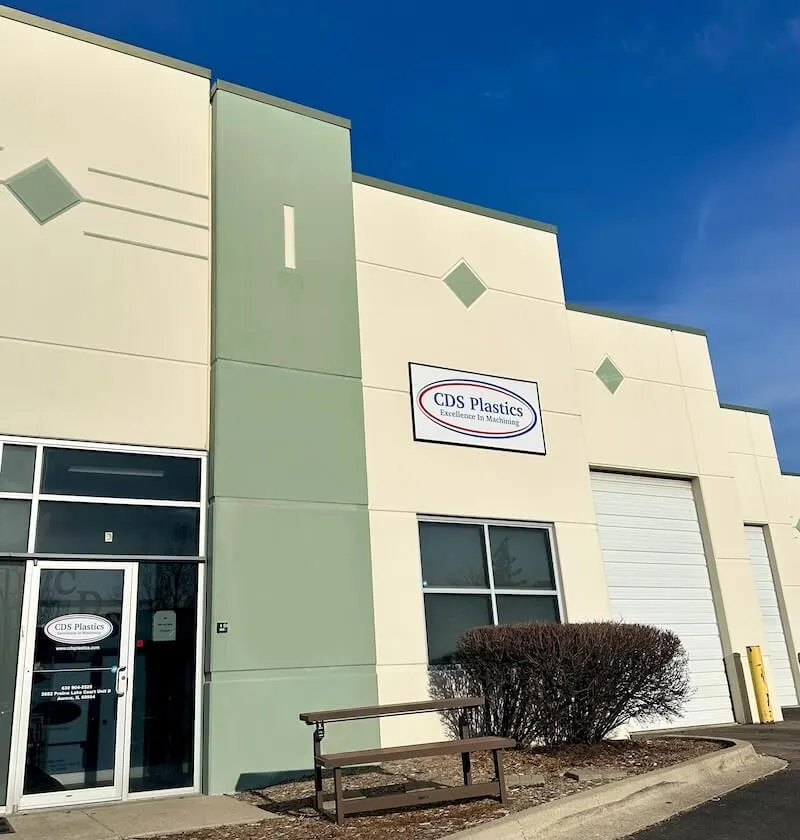
Evaluating a supplier? See the shop and how we check the work.
Buyer questions
Plastic spacer FAQs
Something else? Call (630) 904-2525.
No universal promise is possible. The grade, geometry, clamp load, temperature cycle, moisture and the parts around it all play a part. Tell us those and we’ll suggest suitable plastics.
We hold ±0.002" to ±0.005" on critical dimensions, depending on the plastic. We confirm the installed length and bearing faces with the quote.
Timing depends on the spacer, plastic and quantity, and comes with your quote. For an emergency breakdown, ask about our expedited service.
Not a spacer?
Find the right part
We machine almost any plastic part. If yours isn’t listed, describe it in a quote request.
Standard quote
Ready to send your spacer details?
Experienced help from your first quote to the finished part.