
Custom machined change parts
Plastic conveyor lane dividers
- Job
- Split & hold lanes
- Built as
- One piece, or face on carrier
- Starting point
- Worn divider or drawing
- Delivered
- Machined, or assembled & ready to fit
Machined dividers and wear faces that split product into lanes and hold them there. Matched to your worn divider or made to your drawing, as single parts or assembled and ready to fit. Assembly service
- ±0.002"–±0.005" on critical dimensions
- Family owned in Aurora since 1986
- Expedited service for breakdowns
How dividers fail
Three problems a guide rail doesn’t have
A divider takes contact from both sides while product backs up behind it, often reaching unsupported into the split. That’s why it wears and fails differently.
- DIAGRAM: divider nose, new vs rounded and chipped
Nose wear
01The first-contact nose rounds, chips or develops a burr.
It marks product, disturbs the split and can start a jam.
The nose shape, and any chips or burrs.
- DIAGRAM: divider bowing between supports under side load
Bowing
02A long or thin divider bends under back pressure.
Product squeezes through and crosses lanes.
Unsupported length, thickness and the supports.
- DIAGRAM: wear face worn through to the carrier
Wear-through
03The plastic face wears down to the carrier underneath.
Exposed metal can mark product or raise contamination concerns.
How much face is left, and the carrier.
Or the cause is elsewhere
Things to check, not a diagnosis.
- A changed product size, shape or stiffness
- Misaligned infeed or uneven accumulation
- Loose, bent or shifted supports, or a changed lane pitch
- Debris catching on the nose
What defines a divider
Shaped by the lanes it creates
A divider is shaped by the product it splits and the lanes it creates, as much as by its own size.
-
The product
- Footprint and height
- Weight and orientation
- How fragile it is
- Marking to avoid
-
The lanes
- How product arrives
- Number of lanes out
- Lane widths and centers
- Where the split starts
- Transfer gaps and back pressure
-
The divider
- Nose shape
- Length, height and thickness
- Support and mounting
- Rails, belts, nests or tooling it meets
Getting a quote
Start with what you have
Any one of these is enough to get a quote started. Pick yours to see what helps.
Send the drawing and we machine to it.
- Quantity
- Plastic, if specified
- Face, carrier or both
Upload drawings, CAD files or photos on the quote form.
Send the old divider, with its carrier if it has one.
- A photo of the lanes
- Product size
- Quantity
Upload drawings, CAD files or photos on the quote form.
Sketch the lanes and add what you know. We’ll ask for the rest.
- Lane widths and count
- Divider length and height
- How it’s mounted
Upload drawings, CAD files or photos on the quote form.
Plastics for dividers
Common choices, and why
A slippery face has to be balanced against stiffness: a thicker divider bows less, but it takes up lane width.
- UHMW Low friction and abrasion-resistant, and gentle on product.
- Acetal Stiffer, so it holds straightness better over a long split.
- Nylon Strong and wear-resistant. It takes on moisture, which we allow for when machining.
- Detectable grades Metal- and X-ray-detectable plastics, for lines with inspection systems.
- Aluminum For rigid carriers behind a plastic wear face.
Machined in Aurora
How your dividers are made
±0.002"–
±0.005"
On critical dimensions, depending on the plastic. Specs and CAD files are kept, so a reorder matches the last batch.
-
Noses and faces to your layout
The nose, faces and lengths machined to your split and lane widths.
-
Slots for every format
Mounting holes and slots placed for each changeover position.
-
Assembled and ready to fit
Plastic faces and aluminum carriers machined together and delivered assembled, so there’s no second supplier.
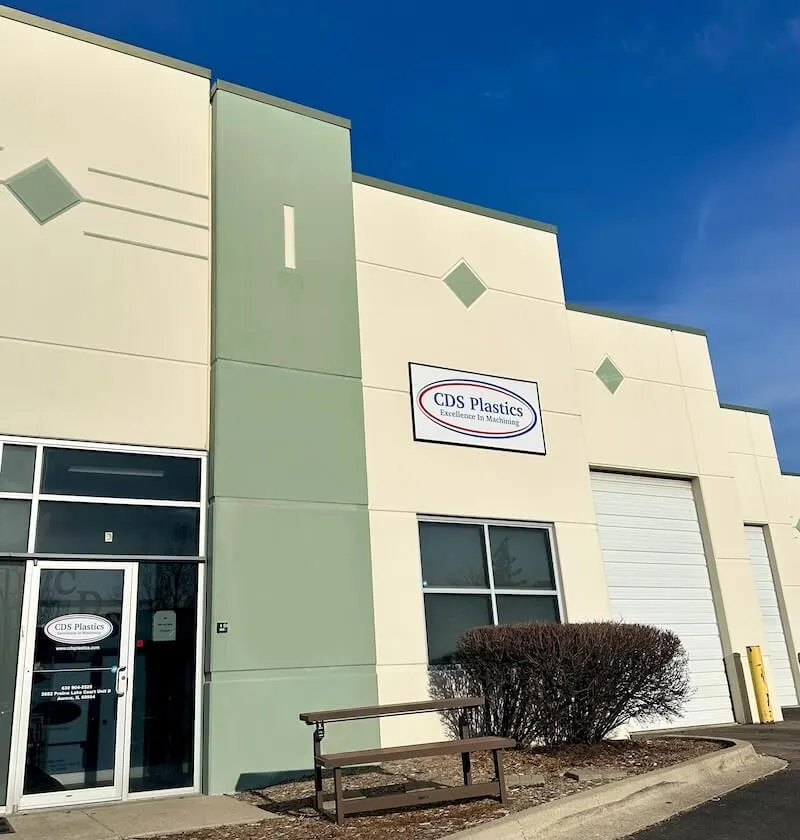
Evaluating a supplier? See the shop and how we check the work.
Buyer questions
Lane divider FAQs
Something else? Call (630) 904-2525.
No. A guide steers product along a run. A divider splits the stream and holds lanes apart, often taking contact from both sides and reaching unsupported into the split, so stiffness matters more.
It can help when the divider is worn or bowed, but it isn’t guaranteed. Product changes, accumulation, infeed alignment and supports all play a part. Tell us what you’re seeing and where it starts.
Food-contact documentation is available for the grades used in food zones. Tell us what your line requires and we’ll quote the right grade.
We hold ±0.002" to ±0.005" on critical dimensions, depending on the plastic. We review your drawing and confirm the critical dimensions with your quote.
Timing depends on the divider, material and quantity, and comes with your quote. For an emergency breakdown, ask about our expedited service.
Not a divider?
What does yours do?
Container-line parts are easiest to name by their job. We machine almost any plastic part, so if yours isn’t here, describe it in a quote request.
Standard quote
Ready to send your divider details?
Experienced help from your first quote to the finished part.