
Custom machined change parts
Plastic turn blocks
- Also called
- Corner blocks & corner tracks
- Guides
- Containers or chain
- Starting point
- Worn block or drawing
- Sets
- With matching straight guides
Machined corner blocks and corner tracks that carry containers or chain through a turn. Matched to your worn block or made to your drawing, from one block to full line sets.
- ±0.002"–±0.005" on critical dimensions
- Family owned in Aurora since 1986
- Expedited service for breakdowns
Why corners wear first
Line pressure pushes into the curve
A straight guide just holds position. At a corner, line pressure pushes every container, or the chain, into the curved face. That’s why a turn block wears faster and differently than the guides either side of it.
-
Entry
Lower loadWhere the straight guide hands containers or chain to the block.
A step or gap at the joint, or a lifted leading edge.
-
Mid-curve
Most side loadLine pressure pushes everything into the curved face here, so it wears first and fastest.
A groove or opened profile in the contact face.
-
Exit
Lower loadWhere the block hands back to the straight guide on the way out.
A step at the joint, or containers catching as they leave.
What defines the block
The curve, sized to your line
The radius, and how the block meets the guides either side, set its shape. We machine to these four things.
-
The turn
- Turn direction
- Angle
- Working radius
- Travel direction
- Flat or inclined
-
What it carries
- Containers or chain
- Chain style
- Container shape
- Filled or empty
- Contact height
- Marking to avoid
-
Contact face and joints
- Entry and exit shape
- Profile of the guides either side
- Gaps or steps at the joints
-
Mounting
- Overall size and thickness
- Support underneath
- Fastener pattern
- Counterbores and slots
Getting a quote
Start with what you have
Any one of these is enough to get a quote started. Pick yours to see what helps.
Send the drawing and we machine to it.
- Quantity
- Plastic, if specified
- The guides it meets
Upload drawings, CAD files or photos on the quote form.
Send the old block and photos of the corner installed.
- Turn direction and angle
- What it carries
- Quantity
Upload drawings, CAD files or photos on the quote form.
Send what you know. We’ll ask for the rest.
- Radius and angle, if known
- Overall size and mounting
- A photo of the turn
Upload drawings, CAD files or photos on the quote form.
Plastics for turn blocks
Common choices, and why
- UHMW Low friction and abrasion-resistant. A common choice for corner tracks and guides.
- Nylon Strong and wear-resistant. It takes on moisture, which we allow for when machining.
- Oil-filled nylon Added lubricity for a lower-friction contact face.
- Acetal Stiff and dimensionally stable, so the curve holds its shape.
- Detectable grades Metal- and X-ray-detectable plastics, for lines with inspection systems.
Machined in Aurora
How your turn blocks are made
±0.002"–
±0.005"
On critical dimensions, depending on the plastic. Curves are milled from solid plastic on our CNC mills.
-
Matched to your guides
Contact face, entry and exit shaped to meet the guides either side without a step.
-
Fit to your mounting
Holes, slots and counterbores where your frame or drawing puts them.
-
Blocks and guides together
Turn blocks with the matching straight guides as a set, with specs kept for reorders.
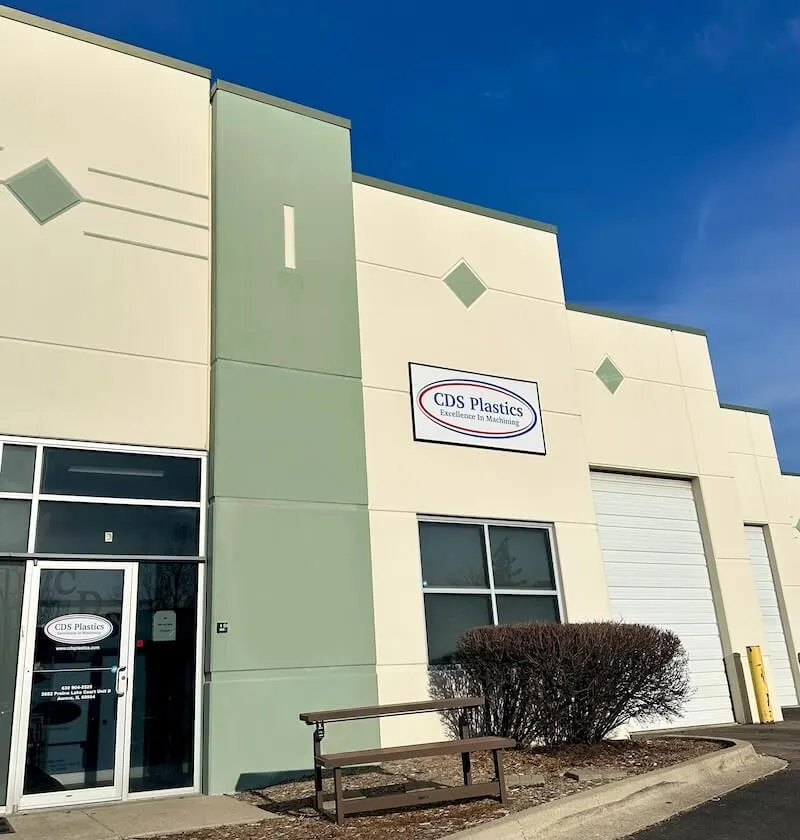
Evaluating a supplier? See the shop and how we check the work.
Buyer questions
Turn block FAQs
Something else? Call (630) 904-2525.
No. A twist block, or inverter, rolls containers over. A turn block carries them round a corner. We machine both, from your drawing or the old block.
It can help when the block is worn, but it isn’t guaranteed. Alignment, line pressure, the guides either side and the containers themselves all play a part. Tell us what you’re seeing and where it started.
We hold ±0.002" to ±0.005" on critical dimensions, depending on the plastic. We review your drawing and confirm the critical dimensions with your quote.
Timing depends on the block, plastic and quantity, and comes with your quote. For an emergency breakdown, ask about our expedited service.
Not a turn block?
What does yours do?
Container-line parts are easiest to name by their job. We machine almost any plastic part, so if yours isn’t here, describe it in a quote request.
Standard quote
Ready to send your turn block details?
Experienced help from your first quote to the finished part.