
Custom machined part
Plastic scraper blades
- Starting point
- Worn blade or drawing
- Mounting
- Fits your holder
- Food lines
- Food-zone & detectable
- Quantity
- One blade to production
Machined plastic scrapers and blades that hold an edge against a moving belt, roll or surface to remove product and buildup. Matched to your worn blade or made to your drawing.
- ±0.002"–±0.005" on critical dimensions
- Family owned in Aurora since 1986
- Expedited service for breakdowns
Where scrapers work
Where plastic scrapers are used
Each job asks something different of the edge, the load and the plastic. Find the one closest to yours.
-
Conveyor belt cleaning
- Removes
- Carryback on the return side, using primary and secondary belt cleaner blades.
- What matters
- Contact angle, belt speed and splices.
-
Rolls and doctor blades
- Removes
- Residue, ink or coating on a turning roll.
- What matters
- An even edge across the roll face, and chemical resistance.
-
Kettles and mixers
- Removes
- Product building up on a vessel wall.
- What matters
- Food-zone requirements, cleaning and fragment detection.
-
Tanks and screens
- Removes
- Sludge and solids in water-treatment equipment.
- What matters
- Constant wet service, abrasion and chemicals.
Scraper anatomy
Edge, angle and holder work together
A scraper only cleans while the right part of the edge meets the surface at the right angle and pressure. These are the details that define your blade.
- Holder The type of holder or bracket the blade sits in.
- Clamp zone Where and how the blade is clamped, with any holes or slots.
- Working edge Edge shape, bevel and thickness at the tip.
- Contact angle The angle the edge meets the surface at.
- Moving surface What it cleans: the material, finish, speed and direction.
- Wear patch Where and how the old blade wore.
Plastics for scraper blades
Common choices, and why
- UHMW Abrasion resistance and low friction. A common choice for food and water-treatment scrapers.
- Acetal A stiffer, more stable edge.
- PTFE Release and chemical resistance. Watch for creep under constant load.
- PEEK For heat, steam and harsh chemicals.
- Nylon Strong and wear-resistant, once moisture uptake is allowed for.
- Detectable grades Metal- and X-ray-detectable grades for lines with inspection systems.
Getting a quote
Start with what you have
Any one of these is enough to get a quote started. Pick yours to see what helps.
Send the drawing and we machine to it.
- Quantity
- Plastic, if specified
- Food-zone or detection needs
Upload drawings, CAD files or photos on the quote form.
Send the old blade and we’ll work from it.
- Photos of the holder
- What it scrapes, and from what
- Quantity
Upload drawings, CAD files or photos on the quote form.
Send what you know. We’ll ask for the rest.
- Length and thickness
- Edge shape and hole pattern
- A photo of it installed
Upload drawings, CAD files or photos on the quote form.
Choosing a blade type
Is a machined plastic blade right?
Plastic suits many scrapers, but not every one. Here’s an honest guide to where it fits.
A good fit
- Gentle on the surface
- Plastic is softer than metal against rolls, belts and vessel walls.
- No rust
- Unaffected by washdown and wet service.
- Detectable options
- Metal- and X-ray-detectable grades for food lines.
- An exact edge and hole pattern
- Machined to match your holder and contact angle.
Machined in Aurora
How your blades are made
±0.002"–
±0.005"
On critical dimensions, depending on the plastic. Specs and CAD files are kept, so a reorder matches the last batch.
-
Edges to your angle
Bevels and working edges machined to the angle and thickness your scraper needs.
-
Fit to your holder
Holes, slots and clamp areas placed to match the holder you already run.
-
One blade to production
A single replacement, a trial blade or recurring runs.
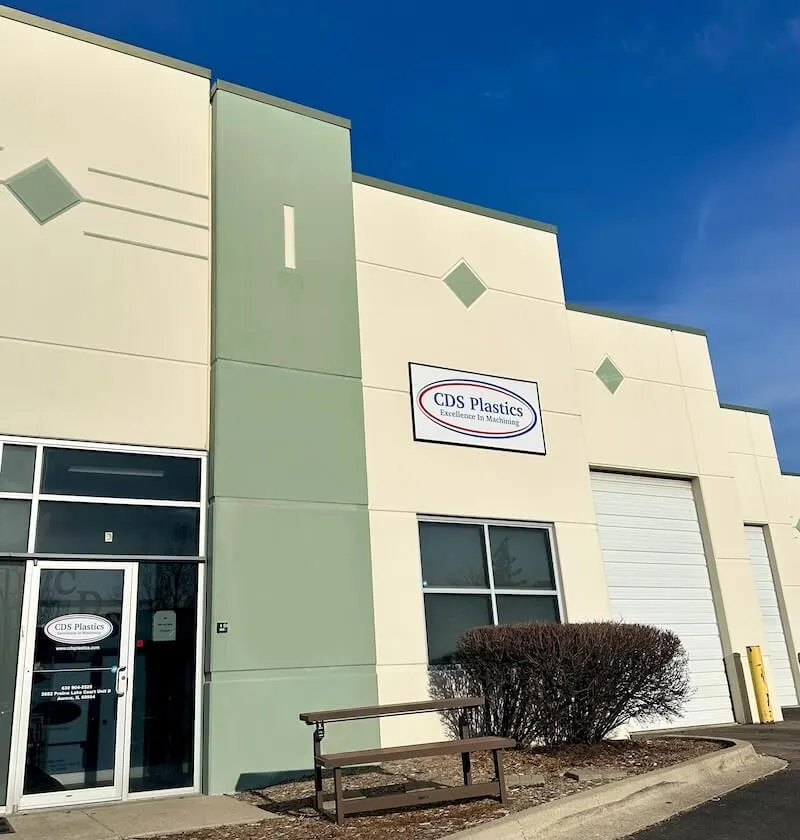
Evaluating a supplier? See the shop and how we check the work.
Buyer questions
Plastic scraper FAQs
Something else? Call (630) 904-2525.
Yes. Metal- and X-ray-detectable grades are available. They work with different inspection systems, so tell us which your line uses.
Food-contact documentation is available for the grades used in food zones. Tell us what your line requires and we’ll quote the right grade.
We hold ±0.002" to ±0.005" on critical dimensions, depending on the plastic. We review your drawing and confirm the critical dimensions with your quote.
Yes. Specifications and CAD files are kept on file, so replacement blades match the last batch. Many buyers order spares to keep on hand.
Timing depends on the blade, plastic and quantity, and comes with your quote. For an emergency breakdown, ask about our expedited service.
Not a scraper?
Find the right part
We machine almost any plastic part. If yours isn’t listed, describe it in a quote request.
Standard quote
Ready to send your blade details?
Experienced help from your first quote to the finished part.