
Custom machined part
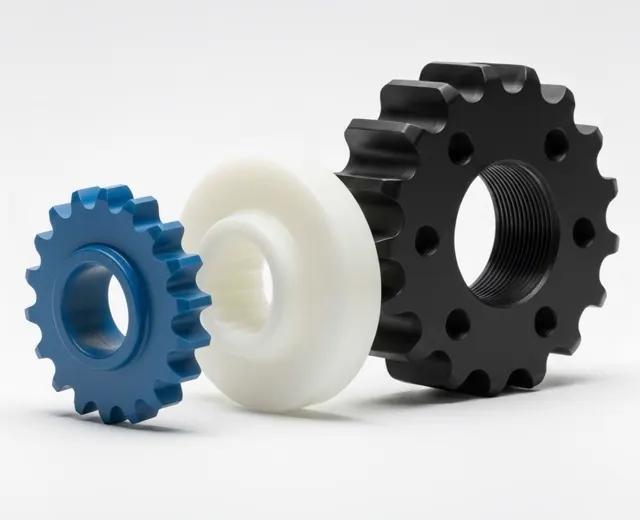
Plastic sprockets
- ANSI roller chain
- #25 to #240
- Metric B-series
- 06B to 24B
- Double pitch & conveyor
- C2040 to C2080
- Size range
- 1"–36" · 9–200+ teeth
CNC machined in UHMW, nylon, acetal and other engineered plastics for roller chain and conveyor chain drives. Replaced from your worn sprocket or made new to your drawing, from one part to production runs.
- ±0.002"–±0.005" on critical dimensions
- Family owned in Aurora since 1986
- Expedited service for breakdowns
Find your chain
The chain number tells us the sprocket
Roller chain is stamped on its side plates. That number sets the pitch and roller size the teeth must fit.
- ANSI
- The digits before the last give the pitch in eighths of an inch: #40 is 4/8", or ½". The last digit is 0 for standard roller chain, 1 for lightweight and 5 for rollerless.
- Metric
- The number gives the pitch in sixteenths of an inch: 08B is 8/16", or ½". It shares a pitch with ANSI but not the roller or width, so the sprockets aren’t interchangeable.
- Double pitch
- Twice the base pitch. A final 2 (C2042) means large rollers, which changes the tooth form, so give the full number.
Can’t read the stamp? Measure across three pitches, pin center to pin center, and divide by three. Or send the chain with the sprocket.
| Chain | Pitch · mm | mm | Note |
|---|---|---|---|
| ¼" · 6.35 mm | 6.35 | Rollerless (bushing) chain | |
| Rollerless (bushing) chain | |||
| ⅜" · 9.53 mm | 9.53 | Rollerless (bushing) chain | |
| Rollerless (bushing) chain | |||
| ½" · 12.70 mm | 12.70 | Standard roller chain | |
| Standard roller chain | |||
| ½" · 12.70 mm | 12.70 | Lightweight, narrower than #40 | |
| Lightweight, narrower than #40 | |||
| ⅝" · 15.88 mm | 15.88 | Standard roller chain | |
| Standard roller chain | |||
| ¾" · 19.05 mm | 19.05 | Standard roller chain | |
| Standard roller chain | |||
| 1" · 25.40 mm | 25.40 | Standard roller chain | |
| Standard roller chain | |||
| 1¼" · 31.75 mm | 31.75 | Standard roller chain | |
| Standard roller chain | |||
| 1½" · 38.10 mm | 38.10 | Standard roller chain | |
| Standard roller chain | |||
| 1¾" · 44.45 mm | 44.45 | Standard roller chain | |
| Standard roller chain | |||
| 2" · 50.80 mm | 50.80 | Standard roller chain | |
| Standard roller chain | |||
| 2½" · 63.50 mm | 63.50 | Standard roller chain | |
| Standard roller chain | |||
| 3" · 76.20 mm | 76.20 | Standard roller chain | |
| Standard roller chain | |||
| Chain | Pitch · mm | mm | Note |
|---|---|---|---|
| ⅜" · 9.53 mm | 9.53 | Same pitch as #35, not interchangeable | |
| Same pitch as #35, not interchangeable | |||
| ½" · 12.70 mm | 12.70 | Same pitch as #40, not interchangeable | |
| Same pitch as #40, not interchangeable | |||
| ⅝" · 15.88 mm | 15.88 | Same pitch as #50, not interchangeable | |
| Same pitch as #50, not interchangeable | |||
| ¾" · 19.05 mm | 19.05 | Same pitch as #60, not interchangeable | |
| Same pitch as #60, not interchangeable | |||
| 1" · 25.40 mm | 25.40 | Same pitch as #80, not interchangeable | |
| Same pitch as #80, not interchangeable | |||
| 1¼" · 31.75 mm | 31.75 | Same pitch as #100, not interchangeable | |
| Same pitch as #100, not interchangeable | |||
| 1½" · 38.10 mm | 38.10 | Same pitch as #120, not interchangeable | |
| Same pitch as #120, not interchangeable | |||
| Chain | Pitch · mm | mm | Note |
|---|---|---|---|
| 1" · 25.40 mm | 25.40 | Double-pitch #40. C2042 is the large-roller version | |
| Double-pitch #40. C2042 is the large-roller version | |||
| 1¼" · 31.75 mm | 31.75 | Double-pitch #50. C2052 is the large-roller version | |
| Double-pitch #50. C2052 is the large-roller version | |||
| 1½" · 38.10 mm | 38.10 | Double-pitch #60. C2062 is the large-roller version | |
| Double-pitch #60. C2062 is the large-roller version | |||
| 2" · 50.80 mm | 50.80 | Double-pitch #80. C2082 is the large-roller version | |
| Double-pitch #80. C2082 is the large-roller version | |||
Hollow-pin, extended-pitch, attachment or conveyor chain? Send the chain maker’s part number or a length of the chain.
Sprocket configurations
Hub, bore and mounting
We machine drive, driven and idler sprockets in the hub style and bore your shaft needs. Match the part you’re replacing, or send the drawing.
- DIAGRAM: Type A sprocket, plate with no hub, side cross-section
Type A · Plate
Flat plate with no hub. Often bolted to a flange, hub or another sprocket.
- DIAGRAM: Type B sprocket, hub on one side, side cross-section
Type B · Hub one side
The hub carries the bore, keyway and set screws for mounting on the shaft.
- DIAGRAM: Type C sprocket, hub on both sides, side cross-section
Type C · Hub both sides
A longer bore for more support on the shaft, common on larger or wider sprockets.
Role in the drive
- Drive
- Transmits power from the motor or gearbox to the chain.
- Driven
- Receives power from the chain to turn the shaft it’s on.
- Idler
- Guides or tensions the chain without transmitting power.
Bore and mounting
- Finished bore
- Bored to your shaft, with keyway and set screws.
- Bushing bore
- Machined to accept a standard QD or taper-lock bushing. Tell us the bushing size.
- Idler bore
- Sized for the bearing or stub shaft the idler runs on.
Getting a quote
Start with what you have
Any one of these is enough to get a quote started. Pick yours to see what helps.
Send the drawing and we machine to it.
- Material, if specified
- Quantity
- Timing you need
Upload drawings, CAD files or photos on the quote form.
Send the old sprocket and we’ll work from it.
- The chain number, if you have it
- A photo of the drive
- Quantity
Upload drawings, CAD files or photos on the quote form.
Send what you know. We’ll ask for the rest.
- Chain number and tooth count
- Bore, keyway and hub style
- A photo of the sprocket
Upload drawings, CAD files or photos on the quote form.
When to replace a sprocket
Signs a sprocket is worn
These are common signs. Your maintenance team or equipment maker decides when it’s time to replace.
-
Hooked teeth
Tooth faces curve over like a wave as the chain rides up them.
-
Thin or pointed teeth
Tooth tips worn narrow or sharp.
-
Chain riding high or skipping
The chain sits up on the teeth or jumps under load.
-
Wear on one side
Teeth worn on one face, often a sign of misalignment.
-
Loose or cracked bore
Play on the shaft, a worn keyway or a cracked hub.
-
Chipped or broken teeth
Missing material from impact or a jam.
-
Check the chain too
A stretched chain wears a new sprocket quickly. It’s worth checking the chain whenever you replace the sprocket.
-
From a worn sample
We work from the chain number and tooth count, so the new teeth fit the chain, not the wear. Reverse engineering →
Switching from steel?
Plastic or steel sprockets
Plastic isn’t right for every drive. It depends on the chain, load, speed and conditions. Tell us how the drive runs so we can suggest suitable plastics.
Where plastic can help
- No rust in wet service
- Plastic doesn’t corrode in washdown, wet or outdoor conditions.
- Runs without grease
- Plastics like UHMW and oil-filled nylon run without external lubrication, so there’s less to contaminate product.
- Lighter to handle
- Easier to lift and fit during replacement, especially on large sprockets.
- Quieter contact
- Plastic teeth are generally quieter against the chain than steel.
- Easier on the chain
- A plastic tooth wears before the chain does, and the sprocket is the cheaper part to replace.
Plastics for sprockets
Common choices, and why
- UHMW Low friction, impact- and abrasion-resistant. A common choice for wet and washdown conveyor drives.
- Nylon Strong and wear-resistant for drive duty. It takes on some moisture, which we allow for when machining.
- Oil-filled nylon Added lubricity for continuous running without external grease.
- Acetal Stiff, dimensionally stable and low in moisture absorption.
- HDPE Chemical resistance for lighter-duty drives.
- Glass-filled nylon Stiffer, with less thermal expansion.
- PVDF and PTFE For aggressive chemical exposure.
- Detectable grades Metal-detectable, X-ray-detectable, or ultra-detectable for both, with a blue color for visual checks.
Machined in Aurora
How your sprocket is made
±0.002"–
±0.005"
On critical dimensions, depending on the plastic. Teeth and features cut on our CNC mills, with bores and hubs machined to your shaft.
-
Send what you have
Drawing, worn sprocket or chain number and photos, plus quantity.
-
We review it
Chain, tooth count, bore and plastic. We ask about anything unclear.
-
You get a quote
Price and timing for your sprockets.
-
We machine them
One sprocket to recurring runs. Specs and CAD files kept for reorders.
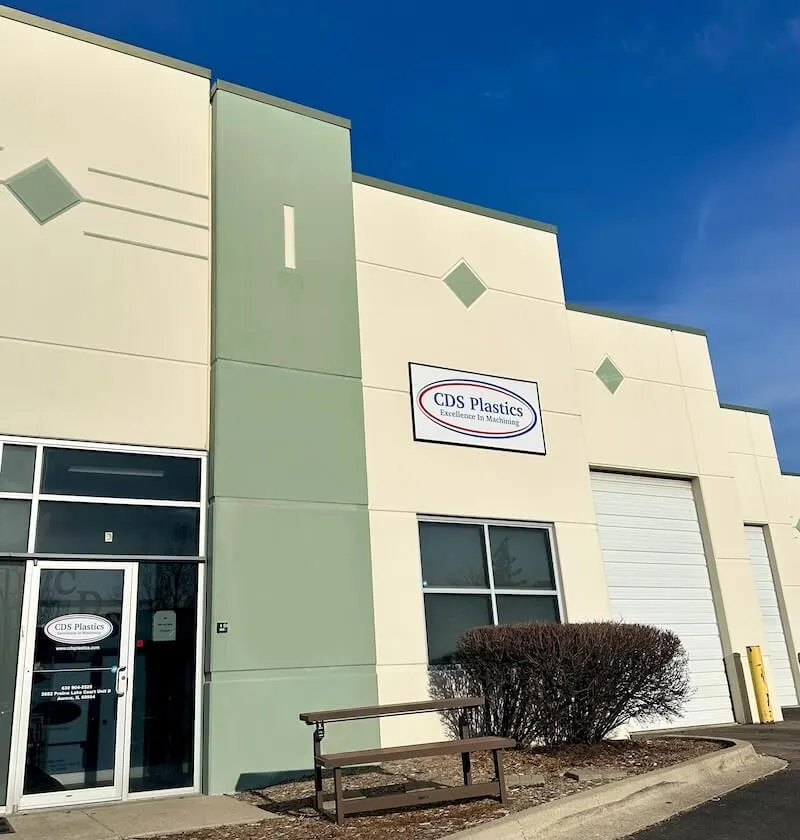
Evaluating a supplier? See the shop and how we check the work.
Where plastic sprockets run
- Food & beverage Washdown conveyor drives, with detectable options
- Packaging Case packer and palletizer drives
- Material handling Sortation and conveyor drives
- Water & wastewater Clarifier and screen drives in constant wet service
- Chemical processing Drives exposed to acids and aggressive washdown
- Agricultural Feed and grain-handling drives, outdoor exposure
Buyer questions
Plastic sprocket FAQs
Something else? Call (630) 904-2525.
Yes. We machine the teeth to suit your chain size, so send the chain number with the tooth count and bore details.
Not in every drive. Plastic sprockets suit many conveyor and moderate-duty drives, but high torque, shock loads, speed or heat can keep steel as the right choice. Tell us how the drive runs so we can suggest suitable plastics.
We hold ±0.002" to ±0.005" on critical dimensions, depending on the plastic. We review your drawing and confirm the critical dimensions with your quote.
Yes. Metal-detectable grades are picked up by metal detectors, X-ray-detectable grades show on X-ray inspection, and ultra-detectable grades work with both and are blue for visual checks. Choose based on the inspection equipment your line uses.
Yes. Specifications and CAD files are kept for future orders, and reorders use a shorter form.
Timing depends on the sprocket, plastic and quantity, and comes with your quote. For an emergency breakdown, ask about our expedited service.
Not a chain sprocket?
Find the right part
Standard quote
Ready to send your sprocket details?
Experienced help from your first quote to the finished part.